Trying to make a Gilbert home work harder for your budget? In a market where home prices and monthly ownership costs are close to local rent levels, house hacking can be a practical way to offset expenses and build long-term value. If you are thinking about buying, renovating, or using part of a property for income, the key is matching your plan to Gilbert’s housing stock and local rules. Let’s dive in.
Why house hacking stands out in Gilbert
Gilbert is not a bargain market, which is exactly why many buyers look for ways to turn a primary home into an asset. Redfin’s March 2026 snapshot shows a median sale price of $580,000, about 45 days on market, and a 98.4% sale-to-list ratio.
Gilbert’s housing profile also helps explain why house hacking gets attention here. The town’s recent housing analysis shows that about 74% of homes are owner-occupied, 86.3% of the housing stock is low-density single-family, and 13.4% is multifamily. That means most opportunities are tied to single-family homes, room rentals, or carefully planned accessory units rather than abundant duplex and fourplex inventory.
There is also a clear cost reason to consider it. The same local housing analysis reports a median rent of $2,028 and a median monthly owner cost with a mortgage of $2,120. When those numbers are that close, many buyers naturally look for ways to reduce out-of-pocket housing costs.
What house hacking can look like
House hacking simply means using your primary residence to help cover your housing expenses. In Gilbert, that usually takes one of three forms: renting out a room or part of your home, building or adding a code-compliant accessory dwelling unit, or buying a small multifamily property if you can find one.
The right strategy depends on your budget, your timeline, your comfort level with shared space, and the property itself. Layout, lot size, access, parking, and private community rules can all affect what is realistic.
Renting a room in Gilbert
For many buyers, renting a room or a separate portion of a primary residence is the simplest entry point. It uses space you already have, which can make it the lowest-capital approach.
Gilbert’s short-term rental guidance includes an important distinction for owner-occupants. If the property is your primary residence and you rent only specific portions, such as one bedroom or a casita, Maricopa County registration is not required, though proof of ownership still must be uploaded during the application process.
That can make a partial-home rental more approachable than a larger construction project. Still, simpler does not mean automatic. If you are considering short-term use, Gilbert requires a Town short-term rental license, a valid Arizona transaction privilege tax license, registration with GovOS, and neighbor notification to adjacent and diagonally across-the-street single-family properties.
Because Gilbert also has a complaint hotline and online complaint process, neighbor relations matter. A layout that protects privacy, manages parking well, and keeps noise low is more likely to work smoothly over time.
Best layout features for room rentals
Some homes are naturally better suited for this strategy than others. In Gilbert, you will usually want to look for:
- A split floor plan
- A bedroom with nearby or dedicated bath access
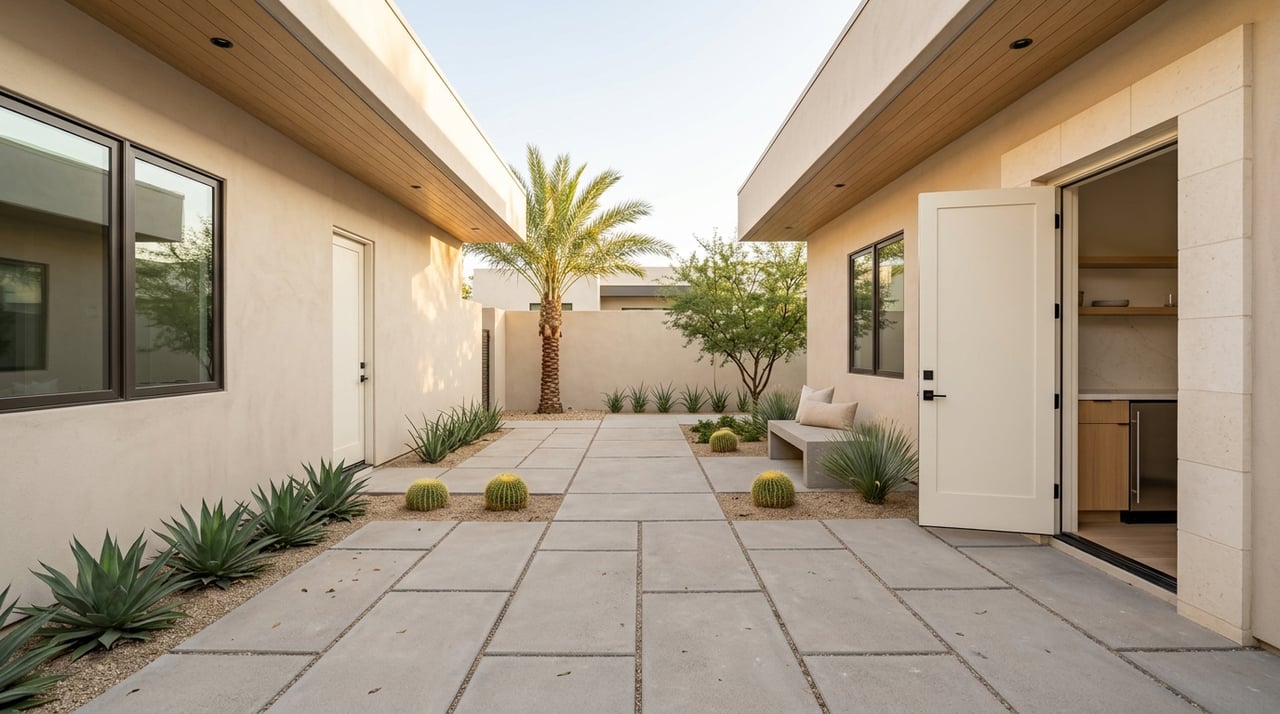
- A casita-style setup or separate entrance
- Driveway or parking capacity that does not create friction
- Good sound separation between living areas
These details are not just about convenience. They can affect day-to-day livability for you and your occupants.
Adding an ADU in Gilbert
If you want more separation and a clearer rental setup, an accessory dwelling unit may be worth exploring. Gilbert’s ADU guide is especially useful because it confirms that ADUs are allowed in all single-family zoning districts.
The guide also says an ADU may include full kitchen facilities. On one lot, Gilbert allows one detached ADU and one attached ADU, as long as they remain subordinate to the primary residence.
There are size rules to keep in mind. An ADU cannot exceed 75% of the gross square footage of the primary home. Units of 1,000 square feet or less may use side and rear setback areas, while units over 1,000 square feet require an Administrative Use Permit in addition to a building permit.
Gilbert also notes that utilities must come from the primary structure’s connections, though a second meter may be requested, and a separate address may also be requested. Those are small details on paper, but they can affect planning, budgeting, and how cleanly the finished setup functions.
ADU planning mistakes to avoid
One of the biggest mistakes is assuming any detached structure can become a rental unit. Gilbert makes a clear distinction here: standard accessory structures such as sheds, detached garages, and pool houses cannot include rooms used for overnight accommodations.
In plain terms, if your goal is rental income, the space needs to be planned as a legal dwelling unit, not as a generic accessory building. That difference matters from day one, because it affects design, permitting, and cost.
Another common issue is underestimating site work and finish requirements. Gilbert’s guide notes that architectural treatment and screened mechanical equipment are required, so your budget should account for more than basic interior improvements.
Why lot and zoning details matter
Not every Gilbert property will support the same house-hacking plan. In many cases, the lot matters as much as the house itself.
Gilbert’s guidance suggests that smaller ADUs can be easier to permit, while larger ones must stay within the building envelope and go through extra review. Larger-lot zoning can also offer more flexibility, which is one reason some properties are better candidates for detached units or guest suite-style setups.
The town’s accessory-structure guidance indicates that certain accessory structures may be placed in side and rear setback areas in SF-15 through SF-A districts, while SF-35 and SF-43 districts allow more rear-lot flexibility and taller accessory structures. While every property still needs specific review, this helps explain why two homes with similar square footage can have very different potential.
What to evaluate before you buy
If you are shopping with house hacking in mind, focus on the features that affect feasibility most:
- Lot size and usable yard area
- Existing access points and privacy separation
- Parking layout
- Space for utility connections
- Whether the home’s floor plan supports room rental
- Whether the property is in an HOA or subject to CC&Rs
This is where practical construction knowledge can help. A property may look promising online, but the real question is whether the layout can absorb changes without driving up renovation costs.
Small multifamily options in Gilbert
Some buyers prefer the classic house-hack model of living in one unit and renting the others. That path can still exist in Gilbert, but it is more selective than in markets with older, denser housing stock.
Gilbert’s housing analysis shows that only 13.4% of housing units are multifamily. In other words, duplexes and fourplexes are part of the market, but they are not the dominant inventory.
That usually means your search may take more patience and speed. If small multifamily is your preferred strategy, you may need to act quickly when opportunities appear and stay open to nearby East Valley areas as well.
Short-term rental rules to know
If your house-hacking plan involves short-term rental income, local compliance matters. Gilbert requires:
- A Town short-term rental license
- A valid Arizona transaction privilege tax license
- Registration with the Maricopa County Assessor, when applicable
- GovOS registration
- Neighbor notification to adjacent and diagonally across-the-street single-family properties
Arizona law also shapes what local governments can require. The state allows cities and towns to require permits or licenses, contact information, neighbor notification, and liability insurance of at least $500,000 or equivalent marketplace coverage.
State law also allows a city or town to require owner occupancy for short-term rentals in properties that contain an accessory dwelling unit if the ADU received final approval on or after September 14, 2024. If you are planning to buy, build, and operate with short-term income in mind, that detail is worth understanding early.
Do not overlook HOA rules
Town approval is only one part of the picture. Gilbert specifically tells owners to check HOA and CC&R rules for both ADUs and short-term rentals.
That means a property can be allowed under town code but still be restricted by private community rules. Before you get attached to a plan, confirm what the neighborhood documents allow.
How to choose the right strategy
The best house-hacking path in Gilbert usually comes down to matching your property and goals to the simplest workable option. For many buyers, that means starting with a room rental or partial-home setup in an owner-occupied property.
If you want more privacy and a stronger long-term layout, an ADU may be the better fit. If your goal is a more traditional income-property setup, small multifamily can work, but your search may be narrower because that inventory is limited in Gilbert.
A smart approach is to evaluate each option through three lenses:
- Feasibility: Does the property and lot support the plan?
- Compliance: Do Gilbert rules and any HOA rules allow it?
- Budget: Will the renovation scope and carrying costs still make sense?
When those three line up, house hacking can become more than a trend. It can be a practical way to reduce your monthly cost, create flexibility, and make your home work harder for you.
If you want help identifying Gilbert properties with real house-hacking potential, from room-rental layouts to ADU-friendly lots and small multifamily opportunities, the Lowery Premier Team can help you evaluate the numbers, the layout, and the renovation scope before you make a move.
FAQs
What is house hacking in Gilbert, Arizona?
- House hacking in Gilbert usually means living in your primary residence while renting out a room, a portion of the home, an ADU, or another unit in a small multifamily property to help offset housing costs.
Can you build an ADU on a single-family lot in Gilbert?
- Yes. Gilbert says ADUs are allowed in all single-family zoning districts, subject to local size, permitting, utility, and design rules.
Does Gilbert allow short-term rentals for part of your home?
- Yes, but local rules apply. Gilbert requires a short-term rental license and other registration steps, and it notes that if the property is your primary residence and only specific portions are rented, Maricopa County registration is not required.
Are sheds or detached garages allowed as rental units in Gilbert?
- No, not as standard accessory structures. Gilbert says accessory structures like sheds, detached garages, and pool houses cannot include rooms used for overnight accommodations.
Is small multifamily common in Gilbert for house hacking?
- It exists, but it is limited compared with single-family housing. Gilbert’s housing analysis says 13.4% of housing units are multifamily, so duplexes and fourplexes may require a more selective search.
Should you check HOA rules before house hacking in Gilbert?
- Yes. Gilbert specifically advises owners to review HOA and CC&R rules because private community restrictions may limit ADUs or rental use even when town code allows them.